How to Potty Train a Golden Retriever Puppy: A Complete, Breed-Specific Guide
how to potty train a golden retriever puppy
Potty training a Golden Retriever puppy is usually easier than people expect, not because the breed is magic, but because Golden Retrievers are unusually food-motivated and eager to please, which makes reward-based training click faster for these puppies than it does for a lot of other breeds. That doesn’t mean it’s effortless. Housebreaking a Golden Retriever puppy still takes a real schedule, a plan for accidents, and a little patience while your puppy’s bladder catches up with the rest of them.
This guide covers the actual step-by-step process for potty training your puppy, a schedule based on your puppy’s age, an honest comparison of the tools people use, and a few things that are specific to this breed, like what to do about muddy paws after every rainy potty break, that most generic puppy training guides skip entirely.
In this guide
- Why food motivation works in your favor
- Build a schedule around your puppy’s age
- Step by step: teaching the routine
- For extra structure
- Crate, pads, or bell training?
- Rainy days: mud and wet fur without breaking the routine
- Handling accidents the right way
- Nighttime and apartment training
- When it’s normal, and when it’s worth a vet visit
- Frequently asked questions
- The bottom line
Why food motivation works in your favor
Golden Retrievers are consistently ranked among the most food-driven breeds, and that’s genuinely useful here. Potty training runs on the same basic mechanic as any reward-based training: your puppy does the right thing, you mark it immediately, and a high-value reward follows within a couple of seconds. A food-motivated puppy connects those dots faster than a puppy who’s lukewarm about treats.
That means small, soft training treats, not their regular kibble, kept right by the door, so the reward happens within a second or two of your puppy finishing, not after you’ve both walked back inside.
Build a schedule around your puppy’s age
A widely used rule of thumb from the RSPCA is that puppies can generally hold their bladder for about one hour per month of age. It’s a starting point, not a guarantee, since some puppies need to go more often, especially early on. The American Kennel Club’s puppy potty training timeline lays out a similar framework, with a bit more detail on what changes as your puppy moves from the very young stage into adolescence.
| Puppy’s age | Approximate time between breaks |
|---|---|
| 8-10 weeks | Every 30-45 minutes while awake, plus after every nap, meal, and play session |
| 2 months | About every 2 hours |
| 3 months | About every 3 hours |
| 4-6 months | About every 4 hours, gradually stretching further |
Beyond the clock, always take your puppy out immediately after waking up, after eating or drinking, and after any burst of play. Those three moments cause more accidents than a missed hourly break ever will.
Step by step: teaching the routine
This routine mirrors the approach recommended by the American Kennel Club, and it works precisely because it’s repeated the exact same way every time.
- Walk your puppy on a leash to the same spot outside every time. The familiar scent helps them understand why they’re there.
- Give them a minute or two to sniff and settle rather than rushing them.
- The moment they start to go, quietly say a consistent cue like “go potty.” Over time this becomes something you can ask for, not just narrate.
- The instant they finish, mark it with an enthusiastic “yes!” and hand over the treat within a couple of seconds.
- Give them a few minutes of relaxed time outside afterward before heading back in, so going potty doesn’t become the signal that fun time is over.
Repeat this exact sequence every single time for the first few weeks. The consistency matters more than any individual step, for a Golden Retriever puppy or any other breed.
For extra structure
A couple of the recommendations below are affiliate links (full disclosure at the end of this article).
The steps above are enough for most Golden Retriever puppies, especially with someone around during the day to keep the schedule consistent. If your days are less predictable, a job that keeps you out of the house for long stretches, for instance, a program that can help with this is Potty Training in 7 Days, which lays out a day-by-day plan built specifically around that kind of schedule.
If that scenario doesn’t quite match your household, another option worth a look is House Train Any Dog, a general step-by-step program that covers both puppies and adult dogs. Either way, think of a program like this as a more detailed version of the routine above, not a shortcut around it; no program replaces real consistency on your part.
Crate, pads, or bell training?
Most guides mention all three of these tools without actually helping you choose. Here’s how they compare honestly, side by side.
| Crate training | Puppy pads | Bell training | |
|---|---|---|---|
| How it works | Dogs instinctively avoid soiling where they sleep, so a properly sized crate discourages accidents when you can’t supervise | Gives a puppy an approved indoor spot, useful for very young puppies or high-rise apartments | Teaches your puppy to ring a bell by the door to signal they need to go out |
| Best for | Nearly every puppy: the strongest foundation tool | Very young puppies, bad weather, or apartments with a long trip outside | Puppies who’ve already got the basics and need a clear way to ask |
| Downside | Requires genuine supervision commitment; it’s not a substitute for potty breaks | Can create a habit of going indoors that takes extra work to phase out later | Some puppies learn to ring it for attention, not just bathroom needs |
For most Golden Retriever puppies, crate training plus a consistent outdoor schedule is the combination that gets there fastest. As the ASPCA points out, dogs instinctively avoid soiling the area where they sleep, which is exactly why a properly sized crate works so well as a training aid. Pads and bells are useful add-ons for specific situations, not replacements for the schedule itself.
Rainy days: mud and wet fur without breaking the routine
This is the part almost no generic potty training guide mentions, and it’s a real, near-daily issue for this breed. Golden Retrievers have a dense double coat and a genuine love of water, which means a routine backyard potty break in the rain can turn into muddy paws and a soaked belly.
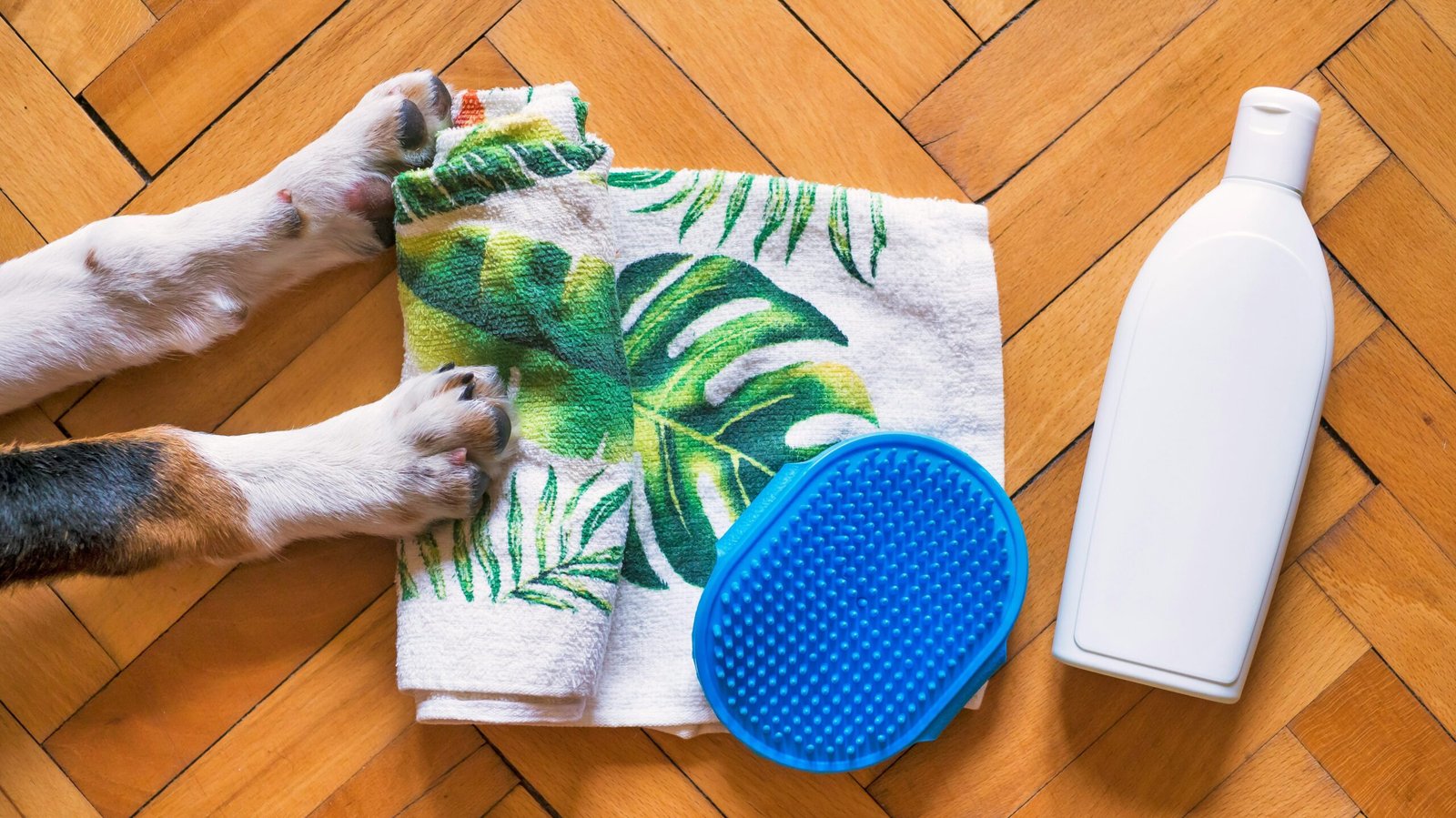
- Keep a towel, or a few, right by the door specifically for this, so wipe-down becomes as automatic as the potty break itself.
- If your yard allows it, choose a designated potty spot on gravel, mulch, or a paved area instead of bare dirt, so mud doesn’t become the default.
- Don’t skip or shorten potty breaks because of weather. A puppy who’s been held through a rainstorm is a puppy far more likely to have an indoor accident.
- A quick rinse-off station (even just a bucket and towel) near the entry point saves your floors without turning every rainy potty break into a full bath.
Handling accidents the right way
Accidents are part of the process, not a sign you’re doing something wrong. What matters is how you respond.

- Never scold or punish after the fact. Your puppy can’t connect punishment to something that happened minutes ago, and it can make them afraid to go potty in front of you at all, even outside.
- If you catch them mid-accident, a calm interruption and an immediate trip outside is enough. No yelling needed.
- Clean the spot thoroughly with an enzymatic cleaner, not a standard household cleaner. As the Humane Society of the United States points out, ordinary cleaners don’t fully eliminate the odor of pet urine, and that leftover scent can draw your puppy back to the same spot.
- If accidents suddenly increase after a period of progress, treat it as information, not a failure. See the regression section below.
Nighttime and apartment training
At night
Pick up the water bowl 2-3 hours before bed, take your puppy out right before you turn in, and expect very young puppies to need one nighttime bathroom trip. Keep it low-key: a quiet trip out and straight back to the crate, without playtime, so your puppy doesn’t learn that nighttime wake-ups mean fun.
In an apartment
The process is identical for an apartment dog, just with a longer commute. Plan your route to the outdoor spot in advance, factor in elevator or stairwell time when deciding how early to leave, and for very young puppies who genuinely can’t hold it that long yet, a temporary puppy pad near the door can bridge the gap until they’re a bit older. Just be consistent about phasing it out once they can make the trip.
When it’s normal, and when it’s worth a vet visit
A sudden dip in progress after weeks of doing well is common and usually isn’t a sign anything has gone wrong. The most frequent causes are a change in routine, a stressful event (a move, new visitors, a change in schedule), or a schedule that hasn’t kept pace with your puppy’s growing bladder capacity.
When to check with your vet instead of just retraining: if regression is sudden and severe, happens alongside straining, unusually frequent urination, or unusual-smelling urine, or if a puppy who was previously reliable starts having frequent accidents with no obvious routine change, these can be signs of a urinary tract infection or another medical